
Executive Summary


- The U.S. economy remained resilient through the third quarter despite higher energy prices, rising interest rates, trade friction, and geopolitical uncertainty. Third-quarter real GDP tracking estimates approached 5%, supported by consumer spending, capital investment, and continued artificial intelligence-related activity.
- Recession risks remain low as stable labor conditions, strong corporate profitability, continued technology investment, and generally healthy credit markets continue to support expansion, although the effects of tighter financial conditions should become more visible over time.
- September payroll growth slowed to 29,000, prior months were revised lower, and unemployment increased to 4.2%. Average hourly earnings rose 3.0% year over year, indicating limited wage pressure and supporting a more measured Federal Reserve approach.
- Inflation continues to moderate from prior peaks. August headline PCE inflation was 3.4% year over year and core PCE was 3.0%, while energy and transportation costs remain important risks.
- The Federal Reserve is expected to proceed cautiously. The September rate increase marked a shift toward tightening, but softer employment and wage data support a pause at the October meeting and suggest that future moves are more likely to be incremental adjustments than the start of an aggressive hiking cycle.
- Housing remains a challenge. Mortgage rates moved above 7%, pressuring affordability and keeping residential activity subdued even as business investment remains strong.
- Corporate profitability remains a major pillar of support. Second-quarter S&P 500 operating earnings increased approximately 50% year over year, margins remained historically high, and expectations continue to point to double-digit earnings growth in 2027.
- Geopolitical and policy risks remain elevated. The U.S.-Iran conflict, oil and diesel prices, midterm-election uncertainty, trade policy, and growing scrutiny of data-center development could influence inflation, interest rates, and sector leadership through year-end.
- Bottom Line: The economic and market backdrop remains constructive but less forgiving. Strong growth, corporate earnings, and business investment continue to argue against recession, while higher interest rates, persistent inflation risks, geopolitical uncertainty, and elevated equity valuations have narrowed the margin for error. A selective approach emphasizing quality, durable cash flows, and improved fixed-income yields remains appropriate.
Dedicated Investment Team:
Andrew Cunningham, CFA®, CMT®, ChFC®
Chief Investment Officer
512.457.7534
andrew.cunningham@plainscapital.com
Central Texas
Jerrod Dawson, CFA®
Manager of Investment Strategies and Portfolio Management
214.252.4150
jerrod.dawson@plainscapital.com
Dallas
Kendall Parker
Manager of Investment Services
214.252.4165
Kendall.parker@plainscapital.com
Dallas
Stephen Schaller, CFA®, CFP®
Market Manager, Portfolio Manager
713.749.8113
stephen.schaller@plainscapital.com
Houston/ Coastal Bend
Victor Tanguma, AIF®
Senior Portfolio Manager
956.661.5466
victor.tanguma@plainscapital.com
McAllen/ Rio Grande Valley
Larry Smith
Senior Portfolio Manager
806.791.7256
larry.smith@plainscapital.com
West Texas
Irene Silva, AWMA ®
Portfolio Manager
817.258.3818
irene.silva@plainscapital.com
Fort Worth
Triana Ramon
Analyst
214.252.4166
triana.ramon@plainscapital.com
Dallas
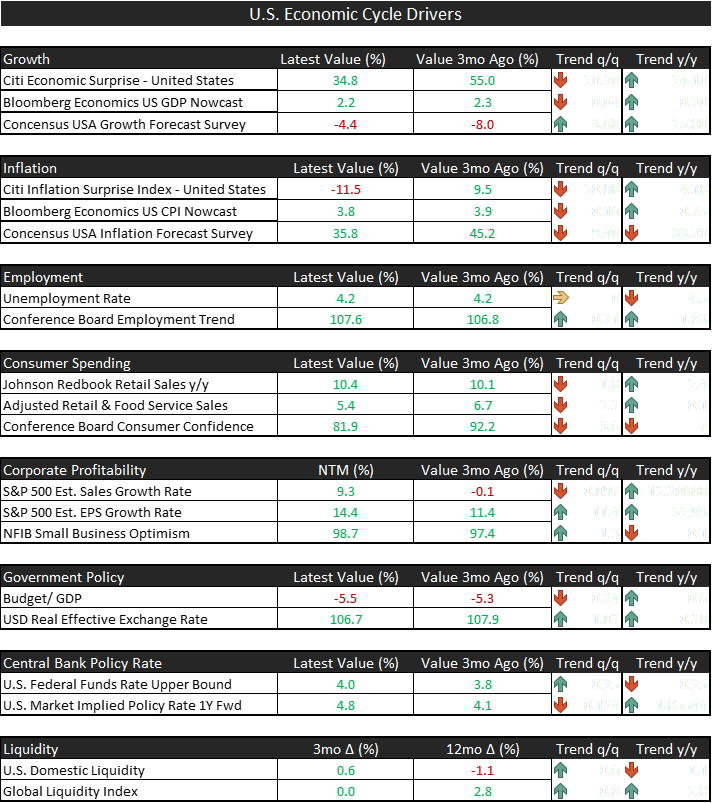
US Economic Cycle Drivers
US & Global Economic Highlights
Economic Activity Remains Surprisingly Resilient:
Despite a Federal Funds rate of 4.0%, sharply higher energy costs — WTI crude has risen approximately 58% over the past year amid ongoing Middle East tensions — and persistent geopolitical uncertainty, the U.S. economy continues to expand. Third-quarter real GDP growth is tracking near 1.8% on a year-over-year basis per Bloomberg consensus, with the Atlanta Fed’s GDPNow model estimating approximately 3.7% on an annualized quarter-over-quarter basis as of late September. Growth is supported by resilient real consumer spending — Q2 personal consumption expenditures were revised sharply higher to +3.8% annualized — and continued artificial intelligence-driven capital expenditure, with major technology companies raising their 2026 investment outlooks materially. While the ISM Manufacturing PMI at 54.5 and other leading indicators continue to signal expansion rather than contraction, consumer confidence has softened and some economists caution that spending durability may be tested by wage stagnation and rising borrowing costs. No broad signal of imminent recession is present, though the pace of growth remains below the administration’s stated 3–4% target. Growth has become more capital-intensive, with data centers, power infrastructure, semiconductor facilities, and manufacturing construction contributing more heavily to activity than traditional interest-rate-sensitive sectors. Business investment is providing meaningful support to overall activity, partially compensating for persistent weakness in residential real estate. The 30-year fixed mortgage rate has risen to 7.40%, and the NAR Housing Affordability Index stands at 69.6 — well below the threshold at which a median-income household can afford a median-priced home — continuing to restrain affordability, turnover, and refinancing activity.
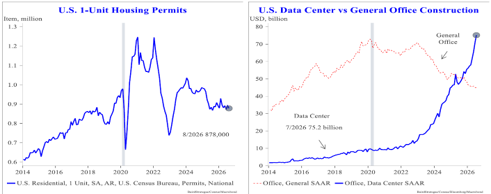
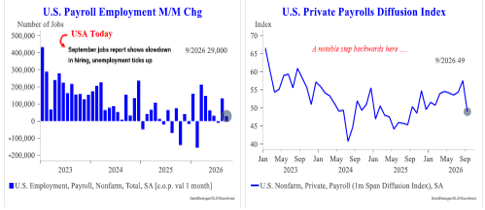
Labor Market Is Cooling, Not Cracking: September employment data reflected a labor market under more pressure than headline figures suggest. Nonfarm payrolls rose by just 29,000 — a sharp deceleration from August’s revised +133,000 and the second-weakest monthly print of 2026 — while the unemployment rate ticked up to 4.2% from 4.1% in August. Wage growth moderated to 3.0% year over year. Initial jobless claims remain low, with the 4-week moving average near 202,000, indicating that employers continue to retain existing workers even as the pace of new hiring has slowed materially. Beneath the surface, however, labor force participation has declined at one of the fastest rates in nearly eight decades of data, mechanically suppressing the headline unemployment rate, while long-term unemployment has risen to levels not seen outside of recessions or the pandemic — with the average job-search duration now exceeding six months. Federal Reserve officials have characterized the labor market as stable and near full employment, though the underlying composition of the data warrants closer scrutiny.
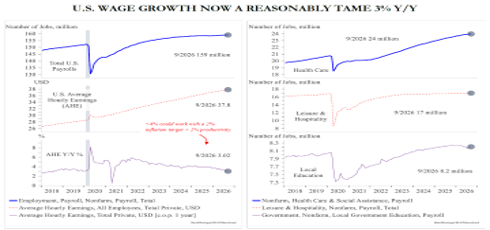
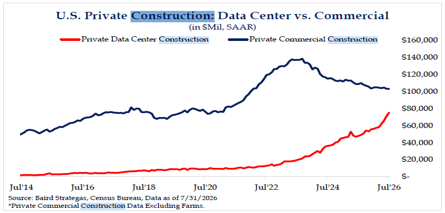
Business Investment Continues to Lead Growth: Nonresidential fixed investment remains among the stronger components of economic activity. Construction of data centers, power infrastructure, semiconductor facilities, and manufacturing capacity continues to expand as businesses respond to growing artificial intelligence demand. These trends have helped offset softer activity in more interest-rate-sensitive sectors.
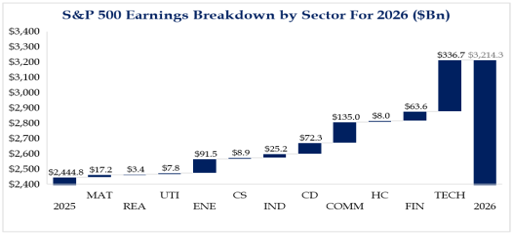
Artificial Intelligence Spending Remains a Major Tailwind: The buildout of AI infrastructure continues to support growth across multiple industries. Demand for semiconductors, cloud capacity, power generation, and data-center construction remains robust. Hyperscaler capital expenditure growth and rising semiconductor revenues reflect the scale of investment flowing into AI-related capacity across the economy.
Housing Continues to Face Interest-Rate Headwinds:
Housing remains one of the economy’s clearest areas of weakness. The 30-year fixed mortgage rate stands at 7.40% (Freddie Mac, Oct 13) up approximately 142 basis points from the cycle low of 5.98% reached at the end of February, just before geopolitical developments drove Treasury yields sharply higher. Affordability has deteriorated to near its worst level since the financial crisis: NAR calculations show that principal and interest payments consumed approximately 27% of median household income in August, with J.P. Morgan characterizing the market as effectively “frozen.” Existing home sales were revised to 3.93 million annualized in August; September closings edged up 1.5% to 3.99 million SAAR — the first monthly gain in four months though this likely reflects a data lag, as most September closings reflect contracts signed when rates were lower. Pending home sales, a more forward-looking indicator, fell 4% in September to near 12-year lows. Refinancing demand has effectively collapsed, with the Bloomberg US MBS Index posting its second-worst monthly performance on record in September and mortgage bond fund outflows ranking among the seven worst since 2021. Structural supply constraints — the White House CEA estimates a shortage of at least 10 million single-family homes compound the affordability challenge, though the 21st Century ROAD to Housing Act, signed in June 2026, represents the most significant legislative response in a generation.
Energy Markets and Geopolitics Remain Key Risks: WTI crude oil has risen approximately 43% year-to-date to $93.48 per barrel, reflecting continued uncertainty surrounding Middle East developments and global energy supplies. Higher diesel and transportation costs represent a meaningful challenge for consumers, businesses, and inflation trends.
Global Growth Remains Uneven: Global economic performance continues to diverge by region. Economies benefiting from technology investment and AI-related infrastructure spending have generally outperformed. China continues to grow below its historical potential — with 2026 consensus GDP estimated at 4.6% — as property sector weakness, demographic pressures, and subdued consumer demand weigh on the recovery. European growth remains modest at an estimated 1.2%.
Credit Conditions Continue to Support Expansion: Corporate credit spreads remain near post-financial-crisis lows, with investment-grade OAS at 81 basis points — approximately 51% below the March 2023 peak of 163bp — and high-yield OAS at 308 basis points, roughly 41% below the March 2023 peak of 518bp. Spread resilience has been notable: despite 10-year Treasury yields approaching 5.4%, their highest level since 2002, credit risk premiums have shown little movement, with market anxiety largely confined to the government bond market. Major US banks passed the Federal Reserve’s annual stress tests in June, with JPMorgan and Goldman Sachs raising dividends and authorizing buybacks, and BlackRock has noted that corporate fundamentals are broadly improving, with companies deleveraging and strengthening profitability ratios. Financial stress remains concentrated rather than systemic, though several pockets warrant monitoring: Macquarie froze certain private credit funds in September amid concerns over shadow banking sector stress, and Bloomberg flagged that deteriorating credit conditions are casting a cloud over major bank earnings. Strategists at BofA and others have cautioned that spreads appear too narrow relative to the current rate volatility environment, and that a sustained period of elevated bond volatility could be a catalyst for widening.
Bottom Line: The economic backdrop remains consistent with continued expansion, though the pace of growth and the durability of key drivers warrant scrutiny. Growth continues to be supported by real consumer spending — Q2 personal consumption expenditures were revised sharply higher alongside an accelerating contribution from AI-related business investment, with major technology companies raising 2026 capital expenditure outlooks materially. Housing, energy costs, and the interest rate environment remain meaningful headwinds. The IMF, which raised its 2026 global growth forecast to 3.1% on Oct 13, simultaneously warned that the world economy is “nearing the limits of its resilience” as energy costs and financial risks build. The September nonfarm payroll report is a signal that warrants close monitoring; the labor market is likely too weak for an extended tightening cycle, while the Fed has signaled that inflation remains the primary policy focus so long as employment conditions remain broadly stable. ISM Manufacturing PMI over 50 and low layoff rates remain consistent with expansion rather than contraction, though the Conference Board Leading Economic Index has declined 0.699% year over year through August, and NFIB small-business optimism fell to a 3-month low in September — signals that merit monitoring alongside the labor market in coming months. On balance, current evidence remains more consistent with a mid-cycle slowdown than a recession, though the composition of that evidence is less uniformly reassuring than the headline indicators suggest.
Critical points for the economy:
- Growth remains resilient
- Mid-cycle slowdown, not recession
- Hiring is cooling, not collapsing
- Business investment leads growth
- AI infrastructure remains a key tailwind
- Housing remains rate-constrained
- Consumer strength is becoming uneven
- Energy prices pose inflation risk
- Higher yields tighten financial conditions
- Credit markets show limited stress
- Global growth remains uneven
- Risks are rising, but expansion continues
Monetary Policy & Fed Outlook Highlights
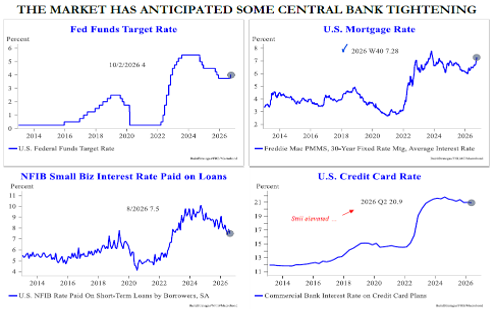
Fed Has Entered a Tightening Phase: The September rate increase — which brought the federal-funds rate to 4.0% — removed one-third of the accommodation delivered across three cuts in late 2025 and confirmed that policymakers are again focused on containing inflation risk. However, current projections and recent communications point toward limited policy adjustments rather than the beginning of a sustained, aggressive hiking cycle. Policymakers have time to assess incoming information, and the expected path remains one of policy “tweaks” rather than an aggressive cycle.
September Employment Data Support a Pause: Nonfarm payrolls increased by just 29,000 in September — a sharp deceleration from August’s 133,000 — while unemployment held at 4.2%, labor-force participation rose to 61.8%, and average hourly earnings increased 0.1% for the month and 3.0% year over year. These readings reduce the urgency for another immediate increase and support a pause while policymakers evaluate the cumulative effect of higher rates on an economy where hiring has slowed materially.
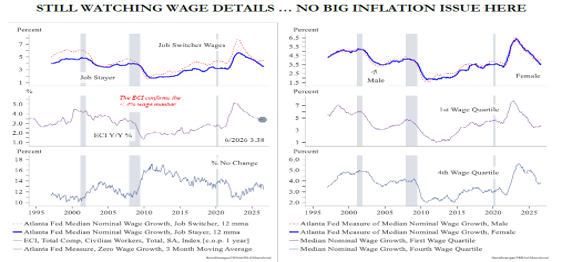
Labor-Cost Pressure Has Eased: Wage growth of 3.0% year over year and the accompanying employment-cost measures suggest that the labor market is not generating significant inflation pressure. Hiring has slowed, but initial jobless claims of 197,000 are not yet signaling broad layoffs. This combination gives the Fed room to move deliberately rather than respond to an abrupt deterioration in employment.
Energy and Supply Shocks Remain the Main Wildcards: WTI crude oil has risen approximately 43% year-to-date to $93.48 per barrel, and tariffs, reduced labor supply, and supply-chain disruptions create additional inflation risks that conventional monetary policy cannot directly resolve. The Fed can nevertheless try to prevent relative-price shocks from spreading into inflation expectations, wages, and broader services prices. This keeps policy biased toward restraint even when the original shock is external.
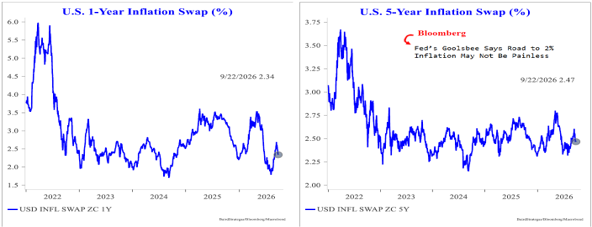
Inflation Expectations Remain an Important Stabilizer: The 10-year breakeven inflation rate stands at 2.35% — anchored near the Fed’s long-run target — while headline CPI remains at 3.4% year over year as of August 2026. The gap between realized inflation and market expectations gives policymakers time to observe incoming information and reduces the immediate need for an outsized response. The Fed’s historical concern is that treating repeated inflation shocks as temporary could allow price pressures to become entrenched.
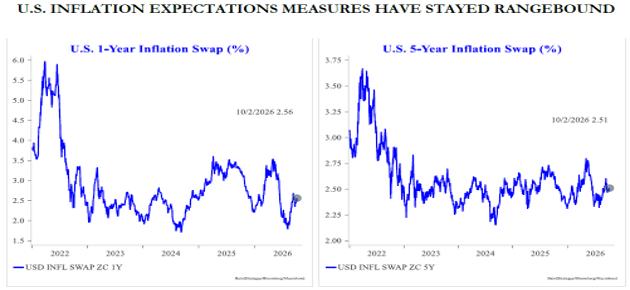
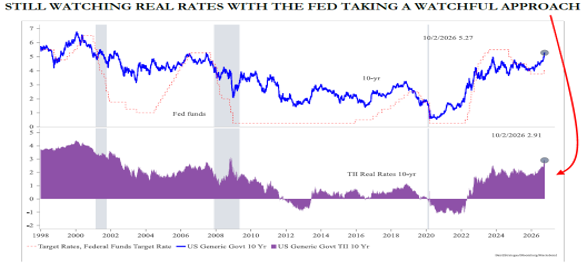
Long-Term Rates Are Doing Part of the Fed’s Work: The 10-year Treasury yield stands at 5.24% as of October 12, despite payroll and inflation data that would ordinarily have been considered supportive for bonds. Higher real yields and term premiums are tightening conditions through mortgage rates, business financing costs, and asset valuations without an equivalent increase in the federal-funds rate.
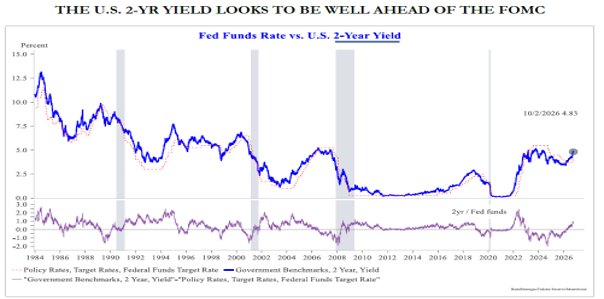
Market Rates Have Moved Ahead of the FOMC: The 2-year Treasury yield of 4.79% sits approximately 79 basis points above the current federal-funds rate, while the yield curve has moved away from its earlier inversion to a 2s10s spread of +45 basis points. These adjustments reflect expectations for tighter policy, stronger nominal growth, and elevated term premiums. Additional Fed action could therefore compound the tightening already occurring through the bond market.
Balance-Sheet Policy Remains Part of the Toolkit: The Fed’s balance sheet — currently $6.75 trillion and growing modestly in 2026 — continues to influence long-term rates and financial-system liquidity. Fixed-income research estimates that the current balance sheet may hold the 10-year Treasury yield roughly 25 to 30 basis points below the level associated with a more normalized balance sheet. Active balance-sheet reduction, should the Fed pursue it, could therefore tighten policy without another increase in the federal-funds rate. Fed officials have indicated that the central bank has time to assess economic data before making another decision. The expected path is therefore a pause followed by a data-dependent adjustment, not an immediate return to easing.
Bottom Line: Monetary policy has become more restrictive, with the federal-funds rate at 4.0% and the 10-year Treasury yield at 5.24%, but current evidence supports a measured path rather than an aggressive hiking cycle. The September payroll print of 29,000 — the weakest reading of the cycle — and moderating wage growth favor a near-term pause, while CPI at 3.4%, energy-related supply risks, and still-resilient economic activity keep further tightening on the table. Higher long-term yields are already doing part of the Fed’s work, increasing the importance of patience and data dependence. The most likely outcome remains a mid-cycle slowdown, with the principal policy risk divided between overtightening into an already-softening labor market and responding too slowly to renewed inflation pressure.
Critical points for policy:
- Fed tightening has resumed
- September labor data support a pause
- Wage pressure has moderated
- Inflation remains above target
- Energy remains the key inflation wildcard
- Inflation expectations remain anchored
- Policy moves should remain incremental
- Another hike remains possible
- Long-term yields are tightening conditions
- Balance-sheet policy remains restrictive
- Global bond volatility bears watching
- Policy favors slowdown, not recession
Corporate Profitability Highlights
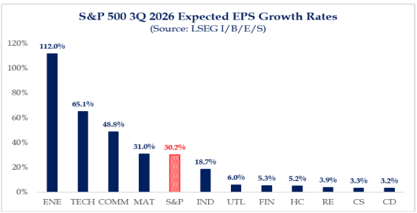
Earnings Growth Remains a Major Support: Second-quarter S&P 500 operating earnings increased approximately 51% year over year — a figure that partly reflects comparison against a weak Q2 2025 base — while full-year 2026 earnings are tracking approximately 33% higher on a consensus basis. This strength helps explain why equities remained resilient despite higher interest rates, energy volatility, and geopolitical uncertainty.
Margins Continue to Absorb Multiple Shocks: S&P 500 LTM operating margins stand at approximately 16.5% — near their highest levels since at least 2021 and up from a trough of 13.7% in 2022 — with the FY2026 consensus estimate of approximately 20% representing a potential multi-decade high. Elevated profitability has allowed companies to absorb cost pressures that might otherwise have produced a sharper slowdown in hiring, investment, or output.
AI Infrastructure Spending Supports Corporate Activity: Data-center construction, semiconductor demand, cloud infrastructure, and related power investment continue to support corporate revenues and capital expenditures. Hyperscaler capital expenditure growth and rising semiconductor revenues reflect the scale of investment flowing into AI-related capacity. Investors are increasingly focused on whether future cash flows will justify the associated spending.
Energy and Input Costs Threaten Future Margin Expansion: WTI crude oil has risen approximately 66% year-to-date to $94.59 per barrel, and higher transportation, computer-component, and financing costs could eventually weaken profits if companies cannot pass increases through to customers. If consumers resist price increases, the cost burden must be absorbed by domestic companies, foreign suppliers, or both, making pricing power an increasingly important differentiator.
Peak-Profit Risk Bears Watching: The main risk is not weak current profitability but whether companies can continue exceeding already-high expectations. LTM margins near 16.5%, a trailing P/E of 26.8x, large capital programs, and WTI crude up 66% year-to-date narrow the margin for error. Future equity gains are likely to depend more on sustained earnings delivery than on additional multiple expansion.
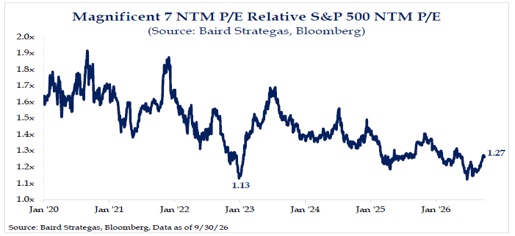
Bottom Line: Corporate profitability remains a major pillar of support for the economy and markets. Full-year 2026 EPS growth is tracking approximately 33%, the 2027 consensus calls for 14.4% growth — a meaningful deceleration worth monitoring — and AI-related investment continues to support revenues, capital spending, and productivity. The principal challenge is that a trailing P/E of 26.8x, WTI crude up 66% year-to-date, higher interest rates, and concentrated leadership have raised the standard companies must meet. The backdrop remains constructive, but future market performance will increasingly depend on continued earnings delivery rather than further valuation expansion.
Critical points for corporate profitability:
- Earnings growth remains exceptionally strong
- Operating margins remain historically high
- 2026 earnings are tracking sharply higher
- 2027 forecasts still call for double-digit growth
- AI investment supports revenues and capital spending
- Tax provisions reinforce business investment
- Productivity helps absorb higher costs
- Credit conditions remain broadly constructive
- Energy and financing costs threaten margins
- Valuations raise the earnings-delivery bar
- Market leadership remains concentrated
- Peak-profit risk bears watching
Disclaimer
The data and commentary provided herein is for informational purposes only. No warranty is made with respect to any information provided. It is offered with the understanding that Hilltop Holdings Inc., PlainsCapital Corporation, Hilltop Securities and PlainsCapital Bank (collectively “PCB”) are not, hereby, rendering financial and/or investment advice, and use of the same does not create any relationship with PCB. This is neither an offer to sell nor a solicitation of an offer to buy any securities that may be described or referred to herein. PCB does not provide tax or legal advice. Please consult your own tax or legal advisor regarding your specific situation. Whether any of the information contained herein applies to a specific situation depends on the facts of that particular situation. Investment and estate planning and management decisions may have significant financial consequences and should be made only after consulting with professionals qualified to offer legal, accounting and taxation advice. Neither this document nor any portion of its content’s supplements, amends or modifies any account agreement with PCB. Unless otherwise noted:
*All economic release data referenced from public sources believed to be accurate
*The source of data for all charts/graphs included in this presentation is Bloomberg LP.
*Figures quoted represent monthly changes (m/m) and are seasonally adjusted
ECONOMIC HIGHLIGHTS