
Executive Summary


- U.S. economic growth continues, led increasingly by business investment.
- Consumer spending has slowed significantly from earlier-year strength.
- Labor market stabilization reduced immediate recession concerns.
- Hiring rebounded in August after notable mid-year weakness.
- Manufacturing remains a key driver of economic expansion.
- Tax incentives continue supporting domestic capital investment activity.
- AI infrastructure spending is boosting manufacturing and productivity.
- Housing activity remains weak amid affordability and rate pressures.
- Higher energy prices have increased inflation and growth risks.
- Current conditions suggest a slowdown risk, not a recession.
- August employment gains strengthened the case for rate hikes.
- Inflation data reinforced expectations for further monetary tightening.
- Markets overwhelmingly expect a September Federal Reserve rate increase.
- Core inflation remains above levels consistent with policy goals.
- Elevated energy prices continue threatening inflation progress.
- Balance-sheet policy is becoming gradually less accommodative.
- Reduced forward guidance has increased interest-rate volatility.
- Long-term yields reflect fiscal, energy, and supply pressures.
- Higher Treasury yields are tightening overall financial conditions.
- Economic resilience persists despite rising policy and market risks.
- Corporate earnings growth remained exceptionally strong during the quarter.
- Earnings gains were heavily concentrated among major technology companies.
- AI infrastructure spending continues supporting revenue and investment growth.
- Semiconductor, healthcare, and industrial sectors delivered solid results.
- Tax policy changes provided meaningful support to corporate profitability.
- Investment-grade borrowers maintain strong access to credit markets.
- Lower-quality credit markets are showing increasing signs of stress.
- Record profit margins remain a significant support for equities.
- Rising financing costs threaten future earnings and margins.
- AI investment returns remain promising, but risks are increasing.
Dedicated Investment Team:
Andrew Cunningham, CFA®, CMT®, ChFC®
Chief Investment Officer
512.457.7534
andrew.cunningham@plainscapital.com
Central Texas
Kendall Parker
Manager of Investment Services
214.252.4165
Kendall.parker@plainscapital.com
Dallas
Stephen Schaller, CFA®, CFP®
Market Manager, Portfolio Manager
713.749.8113
stephen.schaller@plainscapital.com
Houston/ Coastal Bend
Jerrod Dawson, CFA®
Manager of Investment Strategies and Portfolio
214.252.4120
Jerrod.dawson@plainscapital.com
Dallas
Victor Tanguma, AIF®
Senior Portfolio Manager
956.661.5466
victor.tanguma@plainscapital.com
McAllen/ Rio Grande Valley
Larry Smith
Senior Portfolio Manager
806.791.7256
larry.smith@plainscapital.com
West Texas
Irene Silva, AWMA ®
Portfolio Manager
817.258.3818
irene.silva@plainscapital.com
Fort Worth
Triana Ramon
Analyst
214.252.4166
triana.ramon@plainscapital.com
Dallas
Morgan Cook
Analyst
817.258.3705
morgan.cook@plainscapital.com
Fort Worth
US Economic Cycle Drivers
US & Global Economic Highlights
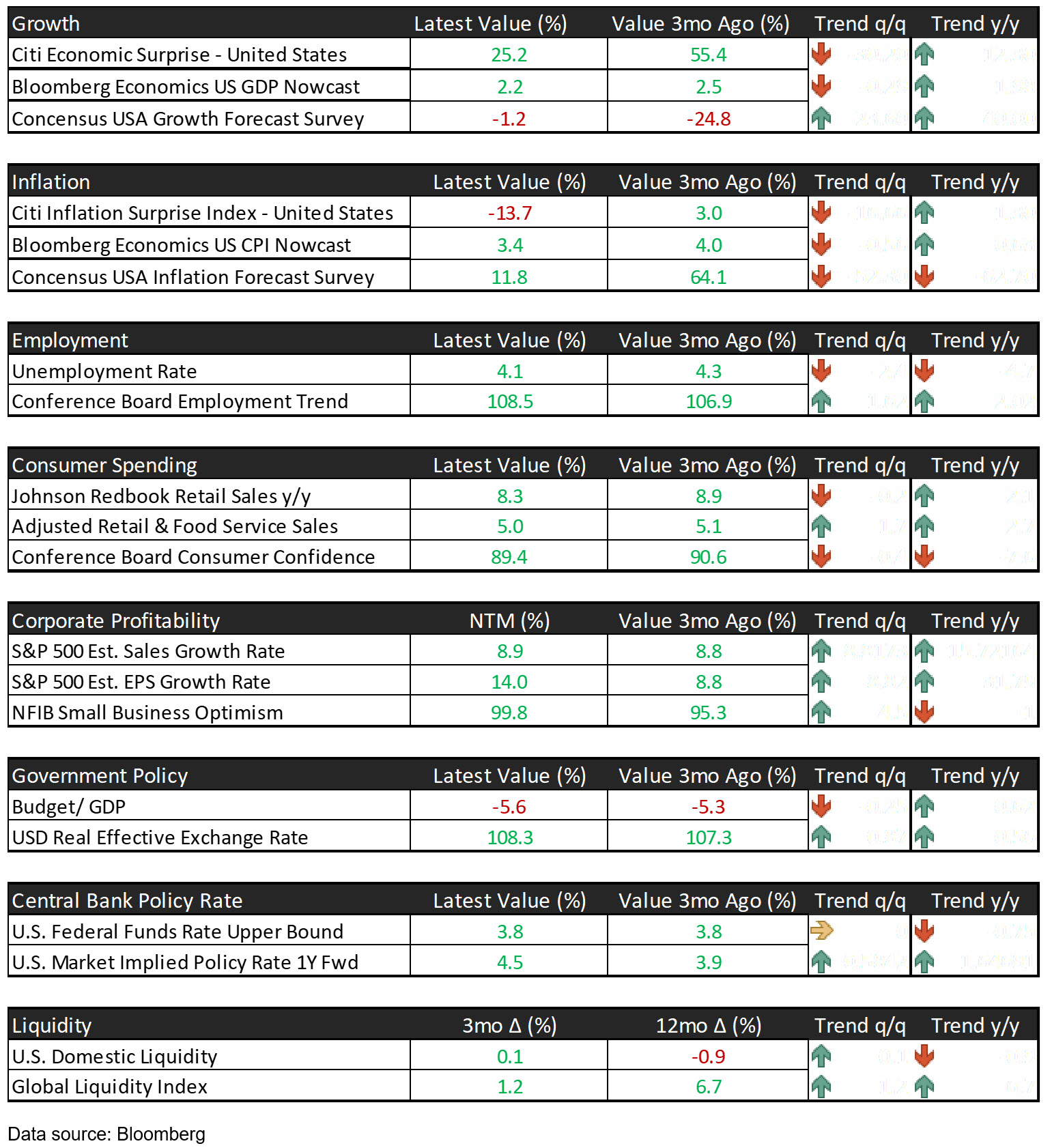
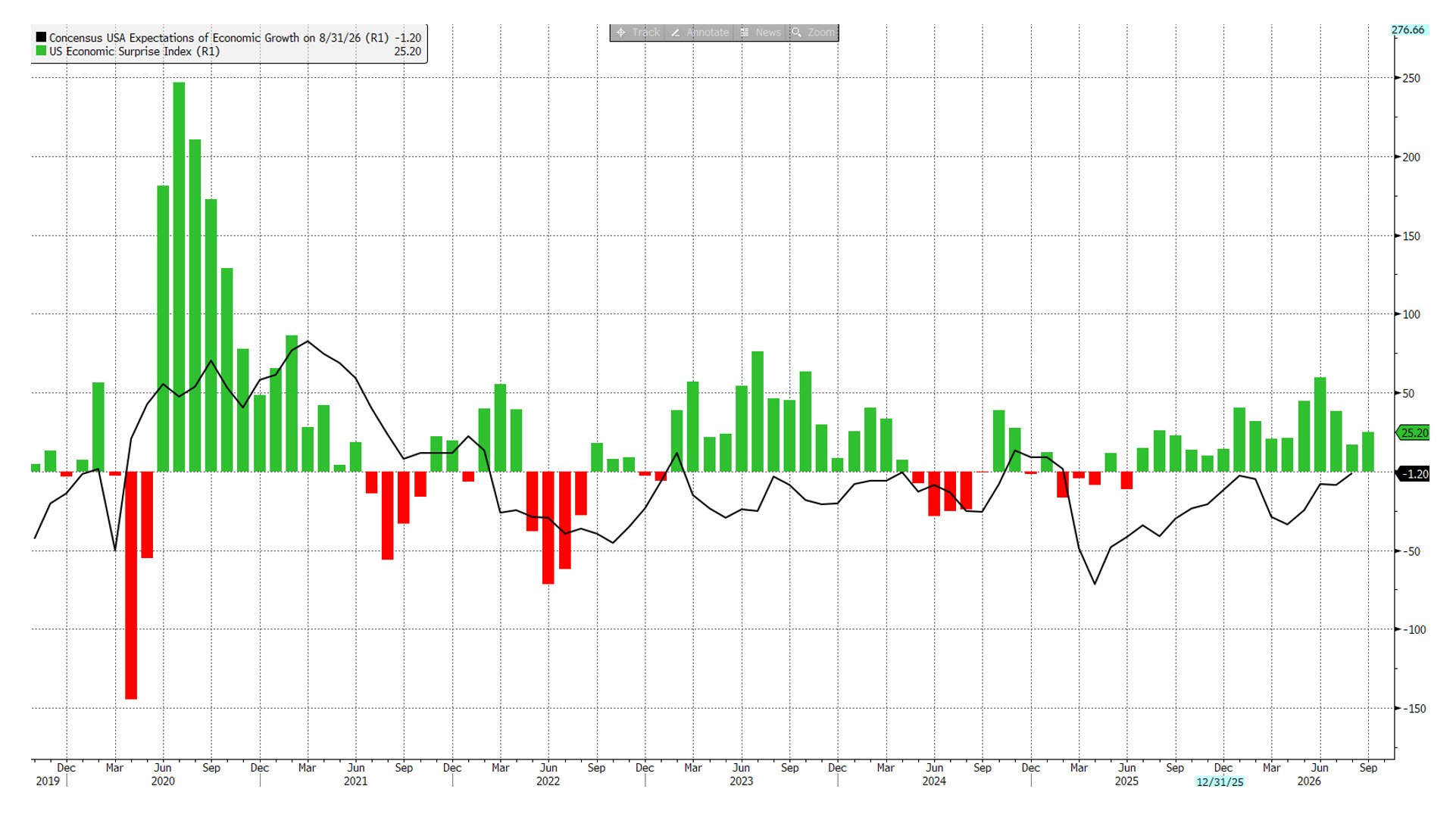
Economic Expansion Continues, But the Mix Has Shifted: The U.S. economy remains in expansion, although growth has increasingly shifted toward business investment rather than broad consumer strength. Capital expenditure and manufacturing remain the principal areas of strength, with real GDP expanding at 2.1% annualized in Q1 and 1.5% in Q2. Consumer spending has decelerated meaningfully — from a peak monthly gain of nearly 1% in March to just 0.2% in July — while employment softened sharply through mid-year before partially recovering in August. Housing activity has been volatile and is trending lower year over year. Consumer confidence has faded since April. Inflation re-accelerated to 4.2% YoY in May, then eased to 3.4% but remains well above target. The trade deficit has widened again after a brief improvement, and the fiscal deficit is tracking near -6.3% of GDP for 2026 — both represent structural constraints on the outlook.
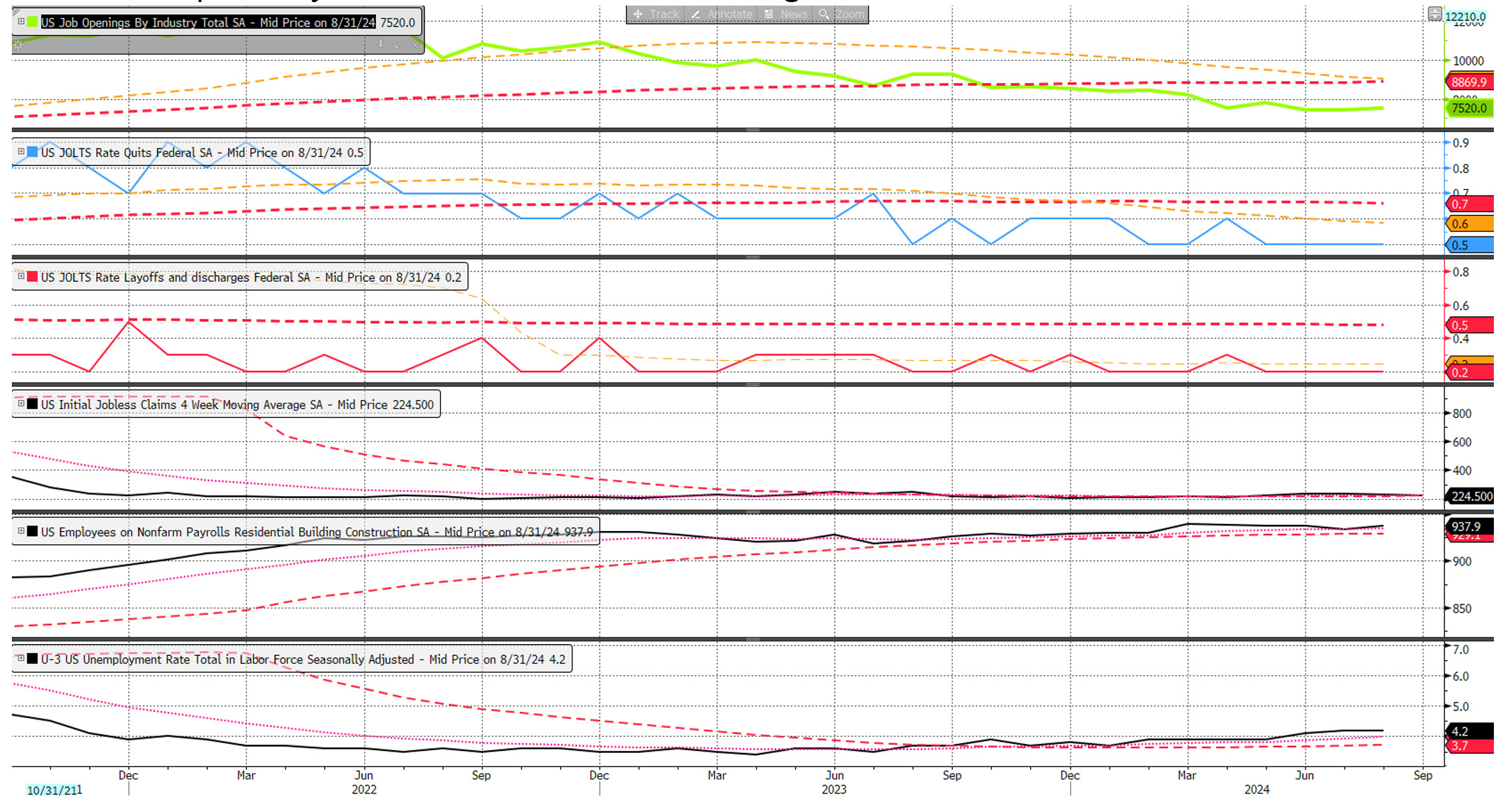
Labor Market Rebounds After a Soft July: August nonfarm payrolls increased by 162,000 and the unemployment rate held at 4.1%, a meaningful rebound from the prior two months in which job gains averaged just 26,000. Initial jobless claims have remained range-bound in the low-to-mid 200Ks throughout 2026, indicating that layoffs have not broadened materially. The August improvement eased the most acute recession concerns, though mid-year softness in hiring—rather than any prior period of unusual strength—is the more relevant baseline. The labor market appears to be stabilizing at a modest pace of job creation rather than entering contraction.
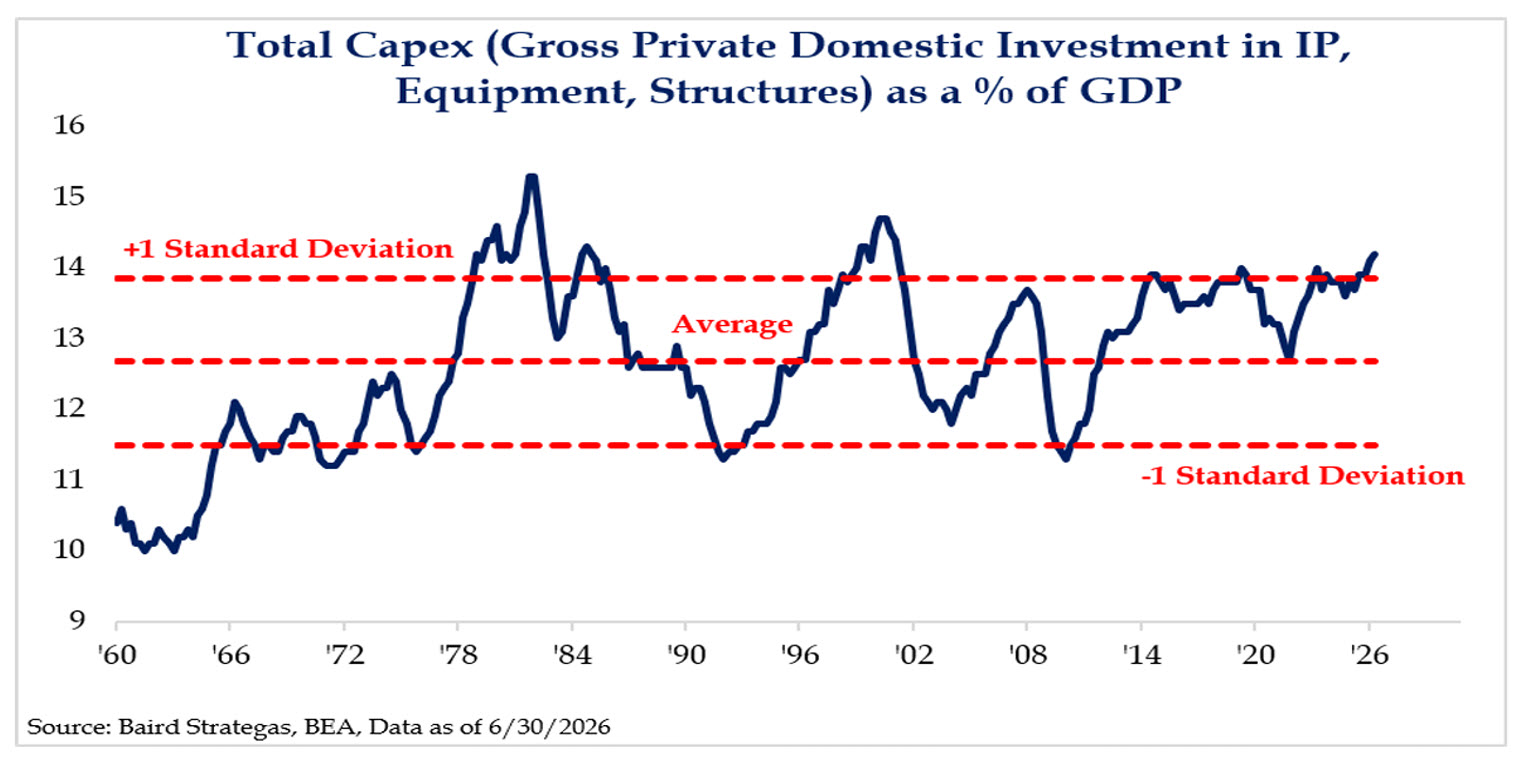
Capital Spending and Manufacturing Lead Growth: Manufacturing remained in solid expansion, with the August ISM Manufacturing Index at 54.6 — well above the 50 threshold and among the stronger readings of the current cycle. Industrial production has trended higher, rising approximately 1.9% year-to-date through July. Tax provisions enacted in 2025—including permanent 100% bonus depreciation, full expensing of research and development costs, and immediate deduction of qualified production property—continue to strengthen incentives for domestic capital investment. However, the R&D benefit faces partial friction from the corporate alternative minimum tax for some firms. These supports are especially important as consumer-led growth moderates.
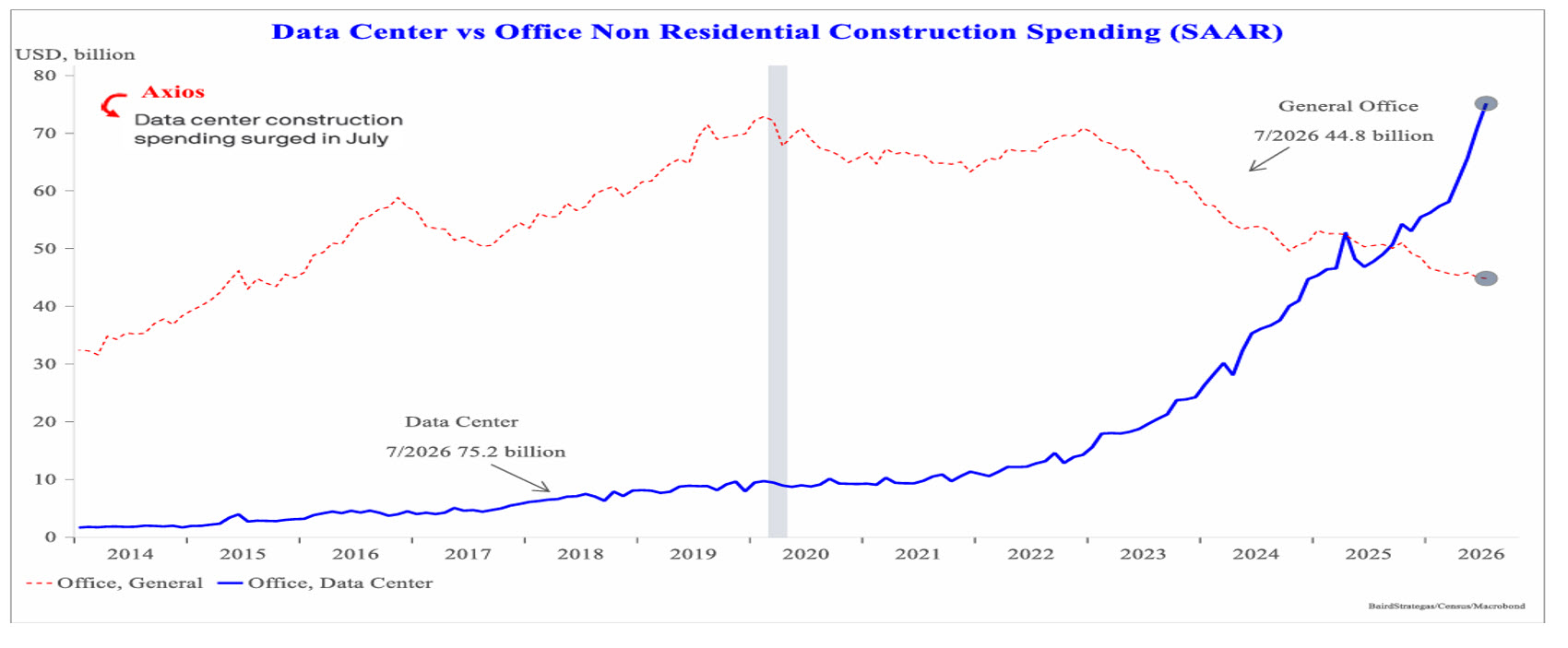
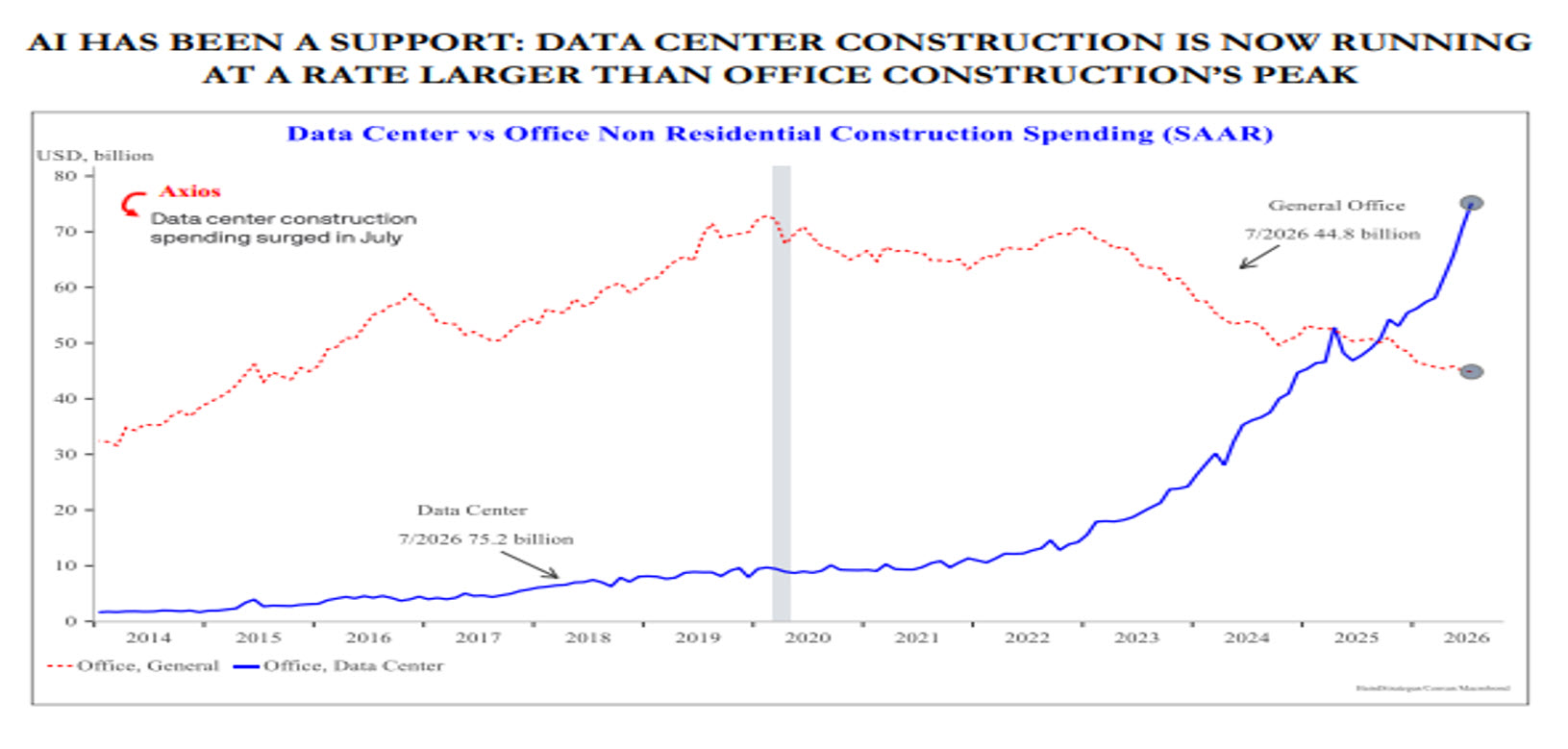
AI Investment Remains a Powerful Economic Tailwind: Data-center construction spending has surpassed the previous peak in office building, according to Census Bureau data, with semiconductor demand and tech spending remaining strong. Nvidia’s Q2 results beat expectations with $96.2B revenue and strong earnings, and its Q3 forecast of $108B exceeded estimates. However, the market response was muted due to disappointing gross margin guidance and a weaker revenue outlook. A $500 billion AI infrastructure financing coalition led by major Wall Street firms highlights the scale of the buildout. This cycle supports manufacturing, power infrastructure, and corporate revenues, with productivity gains expected as deployment expands.
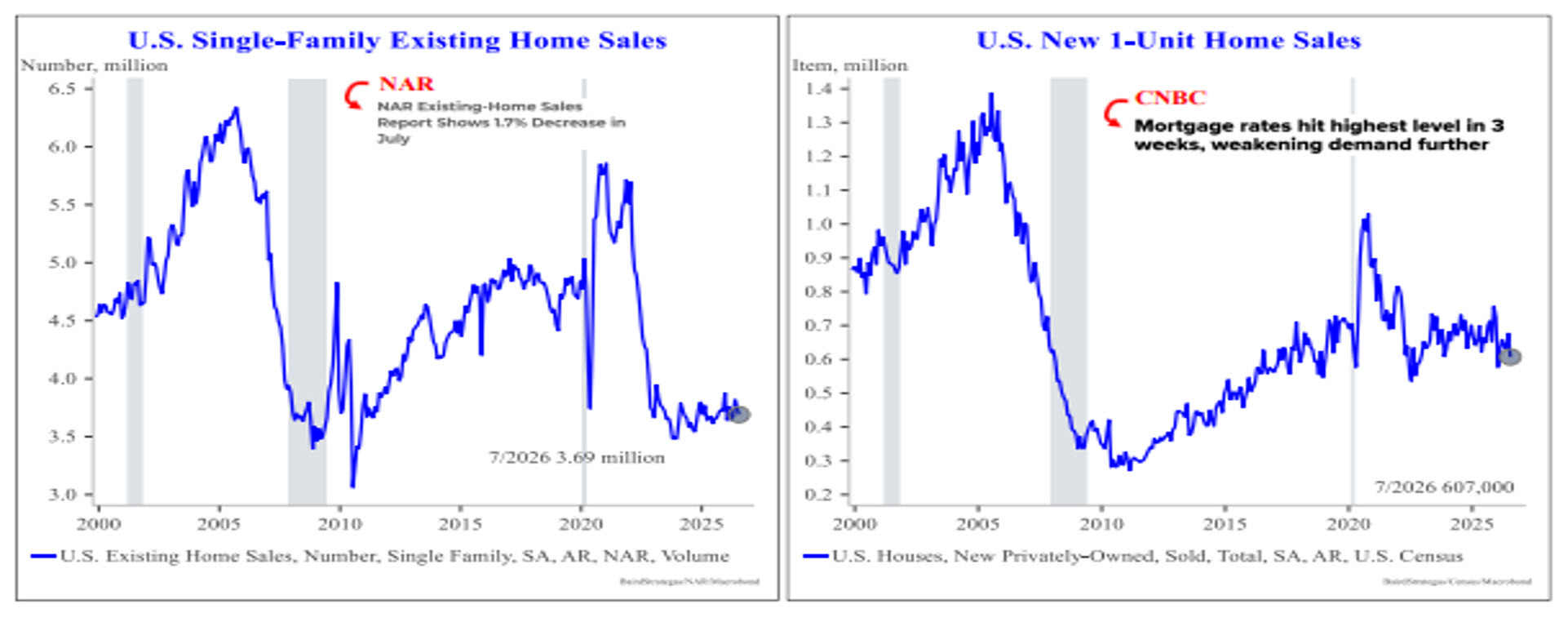
Housing Remains a Clear Weak Spot: New-home sales declined 10.5% in July, mortgage applications have remained predominantly negative week over week throughout 2026, and the 30-year fixed mortgage rate has risen to about 6.75%—the highest level of the year and up roughly 80 basis points since February. Affordability constraints in the existing home market are compounded by a persistent lock-in effect, as owners with sub-4% pandemic-era mortgages remain reluctant to transact. Housing remains one of the most interest-rate-sensitive parts of the economy and has not participated meaningfully in the strength seen in business investment and manufacturing.
Energy and Geopolitics Complicate the Outlook: Oil closed the September 4 week at $91.48 — up approximately 21.6% over one month and 47.9% over one year — before surging above $102 on September 10 as Middle East tensions re-escalated sharply. The Strait of Hormuz, reopened under a US-Iran agreement in June, faces renewed disruption risk following recent US strikes on Iranian targets and ongoing Iran-Oman negotiations over transit control. Ukrainian drone strikes on Russian Arctic gas condensate facilities have introduced new supply risks, while European natural gas inventories — tracking roughly 10 percentage points below the five-year seasonal average — are at their most acute shortfall in nearly two decades, with German grid operators warning their winter storage target is “virtually unattainable.” These developments increase risks to transportation costs, household purchasing power, and inflation.
Bottom Line: Economic conditions remain consistent with continued expansion, but growth has narrowed. Business investment, manufacturing, AI infrastructure, and corporate profits — with S&P 500 net margins at 15% in Q1 — support growth. Consumer activity and housing have softened. Credit conditions, though still generally accommodative, showed stress on September 10 as CDS indices hit multi-week highs and 30-year Treasury yields reached their highest since 2007. Key risks include inflation, energy prices, and rising financing costs. Evidence suggests a mid-cycle slowdown rather than a recession, but recession risk is rising, with Goldman Sachs estimating a 30% 12-month odds, as the energy shock reduces margin for error.
Critical points for the economy:
- U.S. economic growth continues, led increasingly by business investment.
- Consumer spending has slowed significantly from earlier years strength.
- Labor market stabilization reduced immediate recession concerns.
- Hiring rebounded in August after notable mid-year weakness.
- Manufacturing remains a key driver of economic expansion.
- Tax incentives continue supporting domestic capital investment activity.
- AI infrastructure spending is boosting manufacturing and productivity.
- Housing activity remains weak amid affordability and rate pressures.
- Higher energy prices have increased inflation and growth risks.
- Current conditions suggest a slowdown risk, not a recession.
Policy Highlights
Fed Focus Remains on Inflation: The August employment rebound — payrolls +162,000, unemployment steady at 4.1%, and initial jobless claims holding in the low 200Ks — bolstered the case for a rate hike at the September 16 FOMC meeting. Markets are pricing an 85.2% probability of a 25 basis point increase, with the Fed funds target rising from 3.75% to approximately 3.84%. Fed Governor Waller stated his vote would be “heavily influenced” by Friday’s August CPI report, which proved decisive: core CPI came in at +0.3% MoM, above the 0.2% consensus. Today’s August PPI — up 0.4% MoM and 5.4% YoY, the largest monthly gain since May — added to the hawkish case. With limited evidence of broad labor-market deterioration, policymakers retain the latitude to tighten further. However, a gradual decline in labor force participation — which ticked back up to 61.6% in August after drifting lower through much of the year — complicates the read on the unemployment rate.
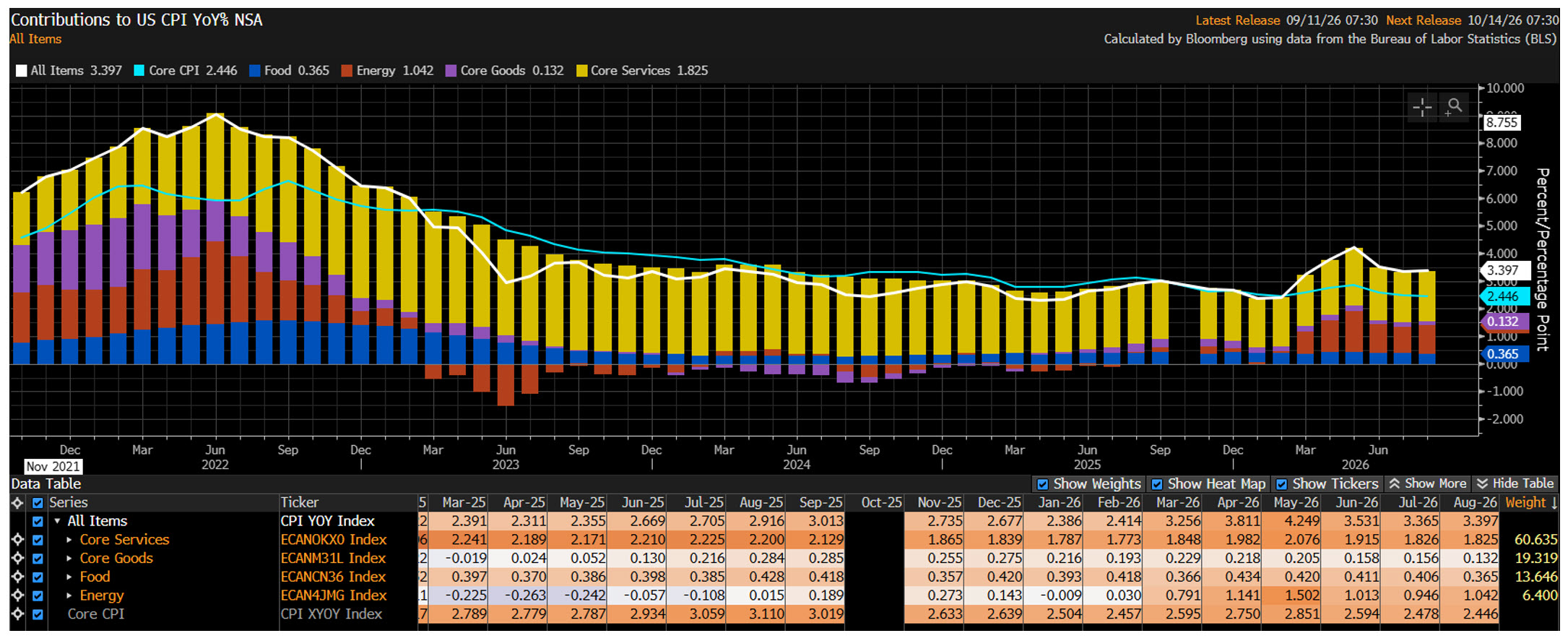
Near-Term Hike Risk Has Increased: The August employment rebound and an ISM Services Prices Paid reading of 72.6 — matching a four-year high — materially strengthened the case for a rate increase at the September 16 FOMC meeting. Today’s August PPI (+0.4% MoM, +5.4% YoY) added further to the hawkish case. This represents a shift from the late-August baseline, when the committee held 9-3 within a target range of 3.50%–3.75% with a conditional posture — “many” participants had already indicated tightening would likely be necessary if inflation failed to decline. The September 16 decision was seen as contingent on Friday’s August CPI report, which Fed Governor Waller and others identified as the decisive input; this morning’s release — core CPI +0.3% MoM, above the 0.2% consensus — has since reinforced the case for action.
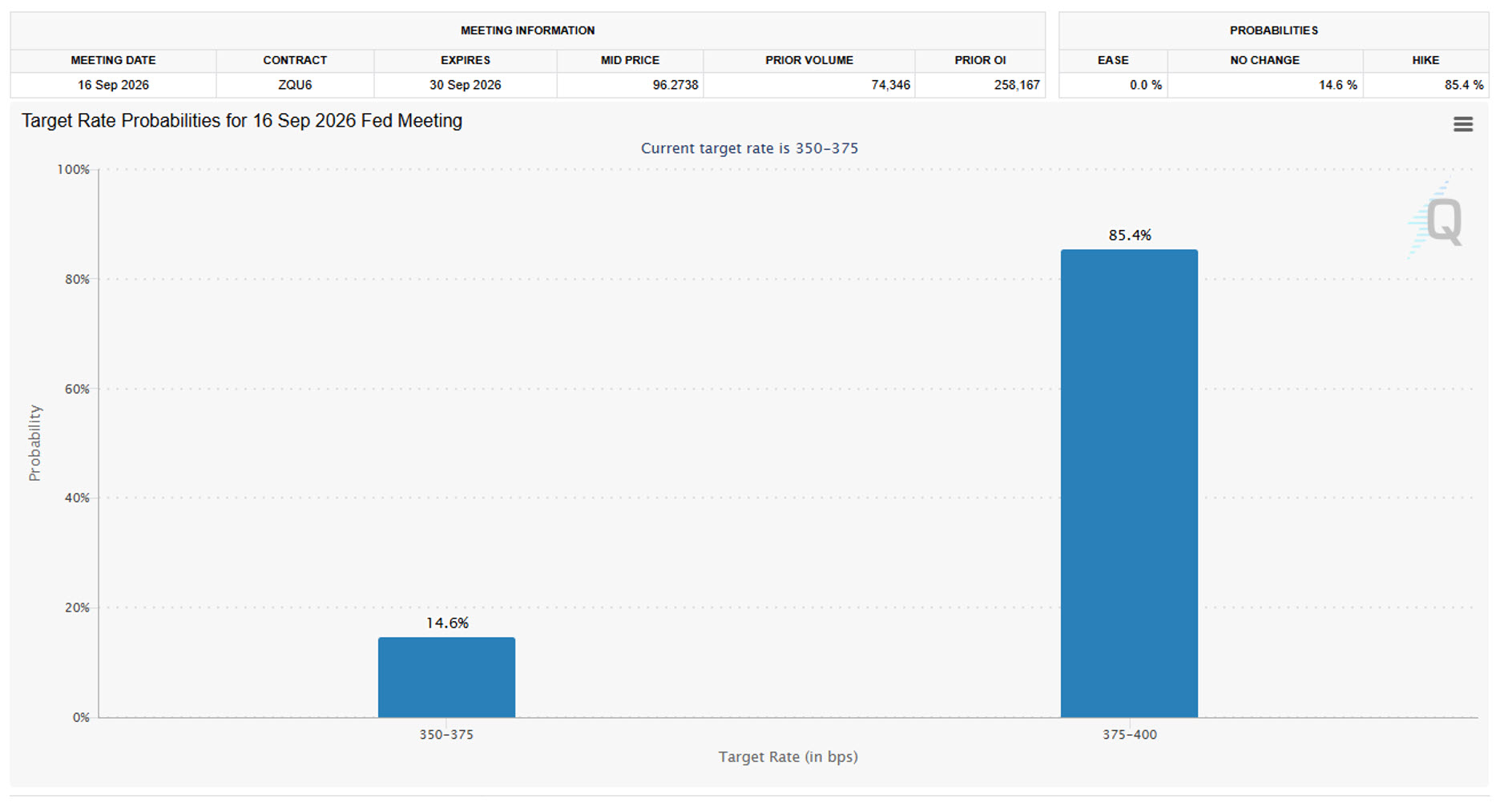
Inflation Risks Remain Unresolved: July headline CPI was 3.4% year over year, core CPI was 2.5%, and core PCE — the Fed’s preferred measure — was 3.3%, an approximately 87 basis point gap that is directly relevant to the policy debate. This morning’s August CPI release showed headline inflation at 3.4% YoY and core CPI at 2.4% YoY, with the latter above the monthly consensus and adding to the hawkish case ahead of the September 16 FOMC decision. Fed Chair Warsh warned in late August that inflation is not “meaningfully slowing” and that the central bank has “work to do.” Higher energy and diesel prices, elevated services inflation, trade restrictions, wage stickiness, and supply-chain restructuring continue to threaten progress toward the 2% objective.
Balance-Sheet Policy Becomes Less Accommodative: The Federal Reserve temporarily paused its Reserve Management Purchase program for the period ending September 14, having accumulated approximately $333 billion of Treasury bills since the program began in December 2025. The pause reflects ample reserve conditions rather than a deliberate policy shift, and the program has not been formally ended. The more consequential balance sheet development is Fed Chair Warsh’s June formation of a task force to review the $6.7 trillion balance sheet and the ample-reserves regime — a structural initiative that could ultimately reshape how the balance sheet is used alongside the federal funds rate, which remains the primary policy instrument.
Reduced Guidance Adds to Market Uncertainty: Warsh’s decision to abandon forward guidance makes each meeting genuinely data-dependent — illustrated most acutely by the September 16 decision, the largest policy toss-up since SVB’s collapse in March 2023, with the outcome potentially hinging on Friday’s CPI print. Without a pre-committed path, short-term yields are more sensitive to individual data releases: the 2-year has risen approximately 111 basis points year-to-date to 4.59%, with sharp intraday moves around each print. Broader rate volatility has increased materially — the MOVE Index is up 31.6% YTD and peaked at 115 in March. The long end has also repriced, with 30-year yields reaching their highest level since 2007 as the term premium expands amid a lack of policy guidance.
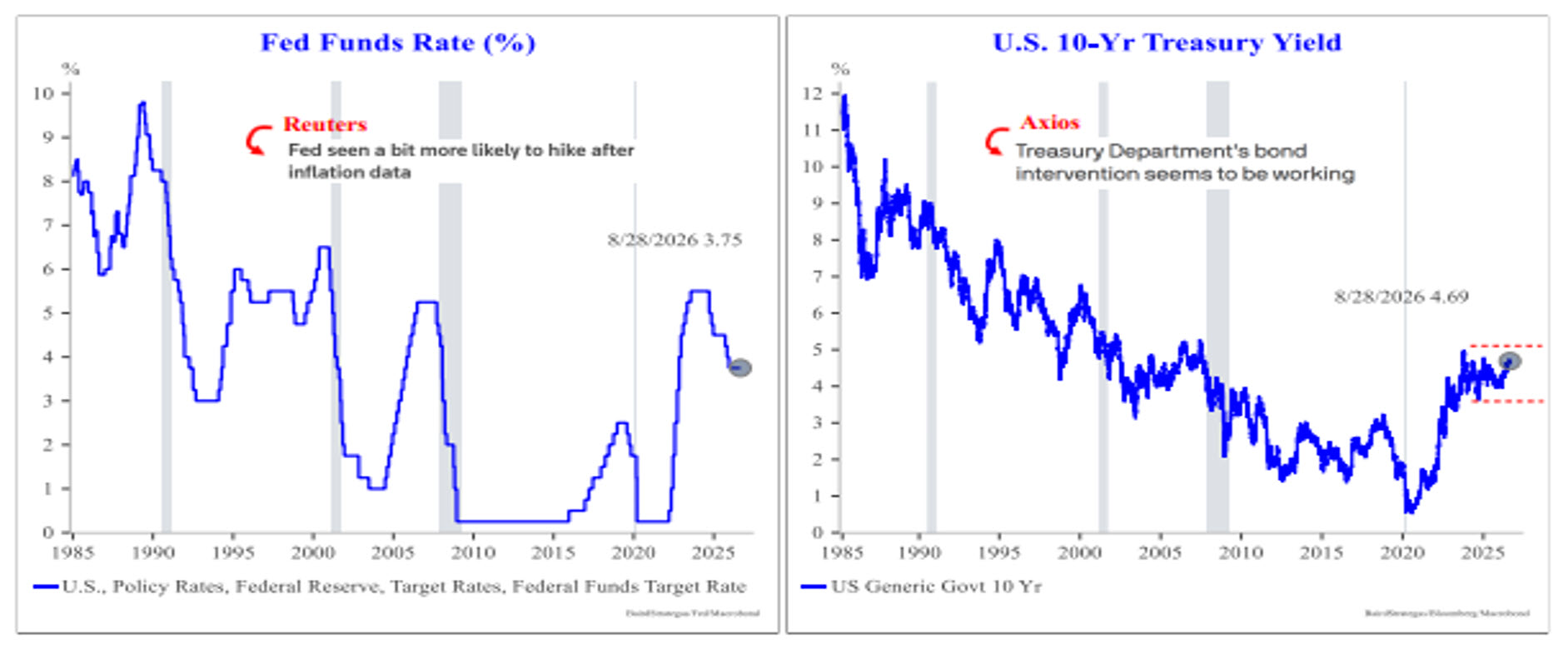
Long-Term Yields Reflect Broader Pressures: Longer-term yields are being driven higher by a combination of heavy Treasury issuance — with public debt now exceeding $40 trillion and the 2026 fiscal deficit estimated at -6.3% of GDP — rising federal interest costs, energy prices, and the normalization of the term premium that had been compressed for years. Treasury Secretary Bessent’s expanded long-end buyback program represents a policy response, though today’s first operation disappointed markets by purchasing fewer bonds than anticipated. These forces can keep the long end elevated even when policy-rate expectations stabilize. The US 10-year yield (4.96%) and 30-year yield (5.37%) are broadly in line with the UK Gilt (5.37%), though the spread over German Bunds (~145 bps) and Japanese JGBs (~200 bps) has widened materially, suggesting US long rates have moved more than some major-economy peers.
Bottom Line: The policy backdrop has become more restrictive and more uncertain. The Fed funds rate stands at 3.75%, the 10-year Treasury yield is approaching 5%, and the 30-year is approaching its highest level since 2007 — with Thursday’s selloff accelerating after the Treasury’s expanded buyback operation purchased only $5.19 billion, well short of the $6 billion maximum, sending 2-year yields up by the most since April 2025. Stronger employment data reduced immediate recession concerns, but persistent inflation and surging energy prices have lifted September hike odds to 85.5% following this morning’s hotter-than-expected core CPI print. Rate hikes may prove less potent than in prior cycles, as the primary inflation drivers — Middle East energy disruption and AI-driven investment demand — are not directly rate-sensitive. Interest-rate decisions remain important, but the disappointing buyback, the trajectory of the Treasury’s debt-management program, and self-reinforcing yield dynamics make balance-sheet policy and market liquidity equally consequential variables.
Critical points for policy:
- August employment gains strengthened the case for rate hikes.
- Inflation data reinforced expectations for further monetary tightening.
- Markets overwhelmingly expect a September Federal Reserve rate increase.
- Core inflation remains above levels consistent with policy goals.
- Elevated energy prices continue threatening inflation progress.
- Balance-sheet policy is becoming gradually less accommodative.
- Reduced forward guidance has increased interest-rate volatility.
- Long-term yields reflect fiscal, energy, and supply pressures.
- Higher Treasury yields are tightening overall financial conditions.
- Economic resilience persists despite rising policy and market risks.
Corporate Profitability Highlights
Earnings Growth Remains Exceptionally Strong: Second-quarter S&P 500 earnings growth reached approximately 50.4% on a blended basis, though the headline figure is heavily concentrated — Alphabet and Amazon together reportedly accounted for roughly 71% of the total earnings increase, with gains driven substantially by paper gains on Anthropic investments rather than operating performance. Excluding these distortions, underlying growth was more modest. Approximately 62.4% of reporting companies exceeded consensus EPS estimates — a positive result, though below the historical average of roughly 73–74%. Sector breadth was nonetheless encouraging, with healthcare (45-1 beat-to-miss), semiconductors (14-0), and industrials posting strong results. Profitability remains a meaningful support for markets, but the composition of Q2 growth warrants scrutiny.
AI Investment Continues to Support Results: Data-center construction, semiconductor demand — with S&P 500 semiconductor revenue growing approximately 51% in 2026 — cloud infrastructure, and related power investment continue to support revenue growth and capital spending. Combined 2026 capex estimates for Amazon, Alphabet, Meta, and Microsoft total approximately $715 billion, with Alphabet alone guiding to $195–$205 billion. Oracle’s cloud infrastructure business grew 121% in its latest quarter, reported tonight, confirming that demand for AI infrastructure remains intact. Investor sentiment is nonetheless more nuanced than headline results suggest: Alphabet fell on its capex guidance, Oracle has faced skepticism over its debt-financed buildout, and rising bond yields are increasing the hurdle rate for new investment just as spending ramps. The AI infrastructure buildout remains an important driver of corporate activity, though execution risk and return visibility are increasingly in focus.
Fiscal and Trade Policy Support Corporate Activity: Full expensing, consumer tax relief, and tariff refunds set in motion by the February 2026 Supreme Court ruling — which struck down most of the administration’s IEEPA-based tariffs and triggered approximately $166 billion in refunds — have supported earnings, capital spending, and economically sensitive sectors. The administration has appealed portions of the ruling and introduced new tariffs under alternative legal authorities, creating two-sided uncertainty: refunds may face further legal challenge. In contrast, new restrictions could partially offset the relief already delivered. The tax provisions have had a measurable impact — Microsoft’s federal tax expense fell from $14.1 billion to $2.5 billion YoY as a direct result of the 2025 tax law.
Corporate credit conditions remain bifurcated. Investment-grade spreads and upper-tier high-yield spreads have widened under pressure today — the CDX IG index saw its largest single-day move in six weeks — but the IG primary market has posted three consecutive record months of issuance, confirming that refinancing access remains open for higher-quality borrowers. Stress is more acute at the lower end: CCC-rated bonds are trading at their widest premium over BB-rated debt in 14 months, private credit default rates are rising — particularly in software and direct lending — and Blue Owl marked a loan to near-zero this week following a Moody’s default determination. Current conditions do not indicate broad recessionary stress, but the bifurcation between investment-grade and lower-quality credit is widening.
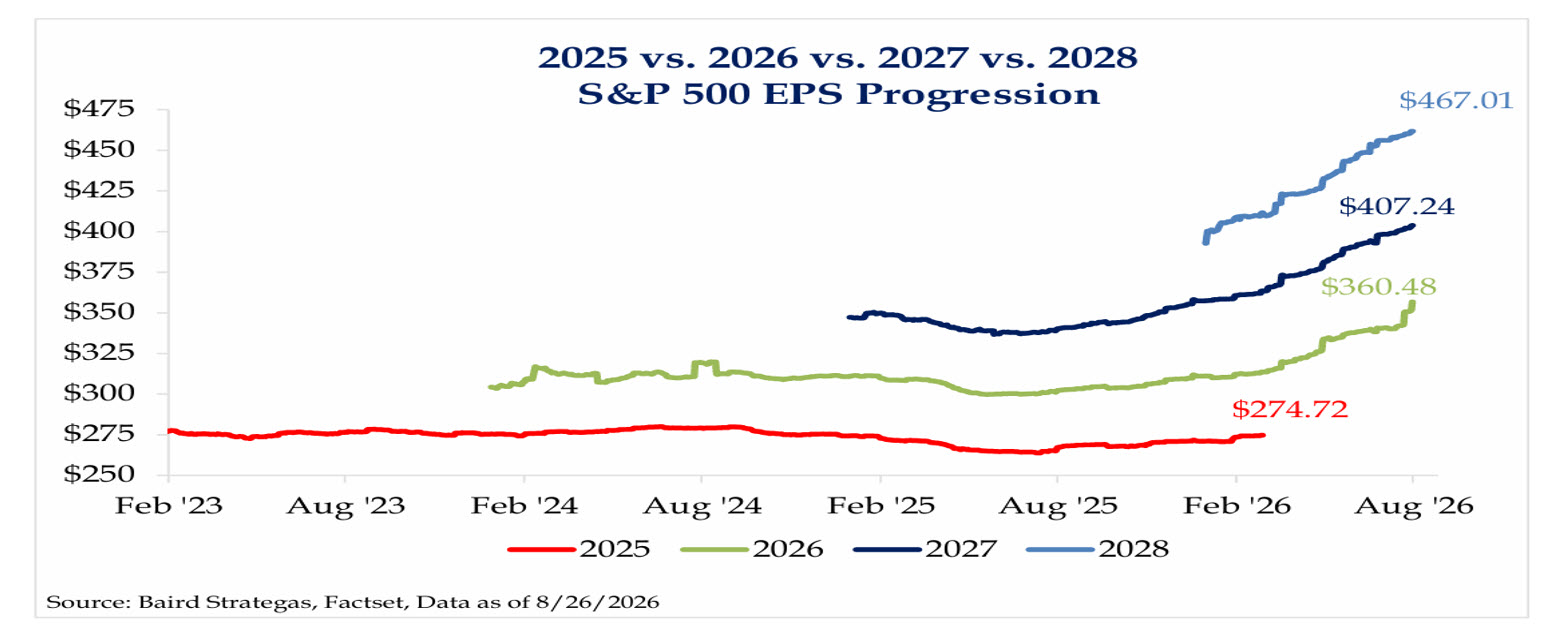
Peak-Profit Risk Bears Watching: The principal risk is not weak current profitability — S&P 500 net margins stand at a record 15.5% — but whether earnings growth can continue to exceed already-high expectations. Consensus implies 15.9% EPS growth from 2026 to 2027, priced at 19.9x forward earnings, with Q2’s beat rate of 62.4% already below the historical average of ~73–74%. Elevated financing costs (30-year yields at their highest since 2007), energy prices, and trade-related costs threaten margins. The capex-return question is sharpening: Alphabet’s cash flow turned negative after raising capex guidance above $200 billion, nine major tech companies have reportedly committed approximately $3 trillion in off-balance-sheet AI obligations, and BofA warned today that investors should hedge AI exposure. Fitch has modeled an AI bust scenario resulting in a 35% equity decline and recession — a tail risk, not a base case. The counterweight is incremental margins: Amazon, Microsoft, and Alphabet added a combined $56 billion in new annualized cloud revenue with strong profit capture per dollar, suggesting returns are materializing for the leading spenders.
Bottom Line: Corporate profitability remains a major pillar of support. Q2 2026 blended EPS growth of approximately 55% — more than double the 23.6% consensus estimate entering the quarter — confirms that earnings have substantially exceeded expectations, and Barclays raised its year-end S&P 500 target to 7,950 this week, citing AI-driven earnings durability. AI-related spending continues to support revenues and investment, with Oracle’s cloud infrastructure business growing 121% in its latest quarter, reported tonight. Credit markets remain broadly open — IG primary issuance has posted three consecutive record months — but are showing increasing stress: CDX indices hit multi-week highs today, BNP Paribas warned that AI-driven debt issuance will eventually end the corporate bond bull market, and HY funds saw outflows last week. The S&P 500 trades at 19.0x forward earnings with consensus implying 15.9% EPS growth in 2027 — a demanding bar at a moment when financing costs, energy prices, trade uncertainty, and investor scrutiny of AI capital spending are all intensifying. Fitch has modeled an AI bust scenario that would result in a 35% equity decline and recession — a tail risk, not a base case, but a formally quantified downside as the economy grows more dependent on technology investment.
Critical points for corporate profitability:
- Critical points for Corporate Profitability:
- Corporate earnings growth remained exceptionally strong during the quarter.
- Earnings gains were heavily concentrated among major technology companies.
- AI infrastructure spending continues supporting revenue and investment growth.
- Semiconductor, healthcare, and industrial sectors delivered solid results.
- Tax policy changes provided meaningful support to corporate profitability.
- Investment-grade borrowers maintain strong access to credit markets.
- Lower-quality credit markets are showing increasing signs of stress.
- Record profit margins remain a significant support for equities.
- Rising financing costs threaten future earnings and margins.
- AI investment returns remain promising, but risks are increasing.
Disclaimer
The data and commentary provided herein is for informational purposes only. No warranty is made with respect to any information provided. It is offered with the understanding that Hilltop Holdings Inc., PlainsCapital Corporation, Hilltop Securities and PlainsCapital Bank (collectively “PCB”) are not, hereby, rendering financial and/or investment advice, and use of the same does not create any relationship with PCB. This is neither an offer to sell nor a solicitation of an offer to buy any securities that may be described or referred to herein. PCB does not provide tax or legal advice. Please consult your own tax or legal advisor regarding your specific situation. Whether any of the information contained herein applies to a specific situation depends on the facts of that particular situation. Investment and estate planning and management decisions may have significant financial consequences and should be made only after consulting with professionals qualified to offer legal, accounting and taxation advice. Neither this document nor any portion of its content’s supplements, amends or modifies any account agreement with PCB. Unless otherwise noted:
*All economic release data referenced from public sources believed to be accurate
*The source of data for all charts/graphs included in this presentation is Bloomberg LP.
*Figures quoted represent monthly changes (m/m) and are seasonally adjusted
ECONOMIC HIGHLIGHTS